
First thing: “Novocaine” isn’t used by dentists anymore… since, like the 1970s. If you use that term, though, we probably aren’t going to correct you, because who really cares? Though, if you read past this line, you must have some interest (or extra time on your hands).
“Novocaine” is the brand name for procaine, a local anesthetic (numbing juice). All local anesthetics work by blocking the signal from an ouchie area of your body to your brain. Its kind of like a telephone line (or internet cable for those in modern times), but someone has blocked the signal in the middle – you can keep chattering away on phone line, but the person at the other end will never hear it. Similarly, when a nerve is blocked with local anesthetic, the brain will never receive signals from any tissue that is hurting.
Yeah, yeah…so back to “Novocaine”
It turns out that procaine/Novocaine, which was discovered in the early 1900s, was a type of local anesthetic that had a high rate of allergic reactions and other side effects. Fortunately, back in the 1940s, someone invented lidocaine, which is a much safer drug with fewer bad reactions. For this reason, it is our workhorse local anesthetic now.
In the dental world, Lidocaine (common brand name: Xylocaine) is usually mixed with a tiny bit of epinephrine (adrenaline). The main purpose is that epinephrine constricts (closes down) small blood vessels in the area of the injection, so it doesn’t get washed away by blood flow so quickly, and can therefore last longer. Another benefit to the epinephrine blood vessel constriction is that it decreases bleeding.
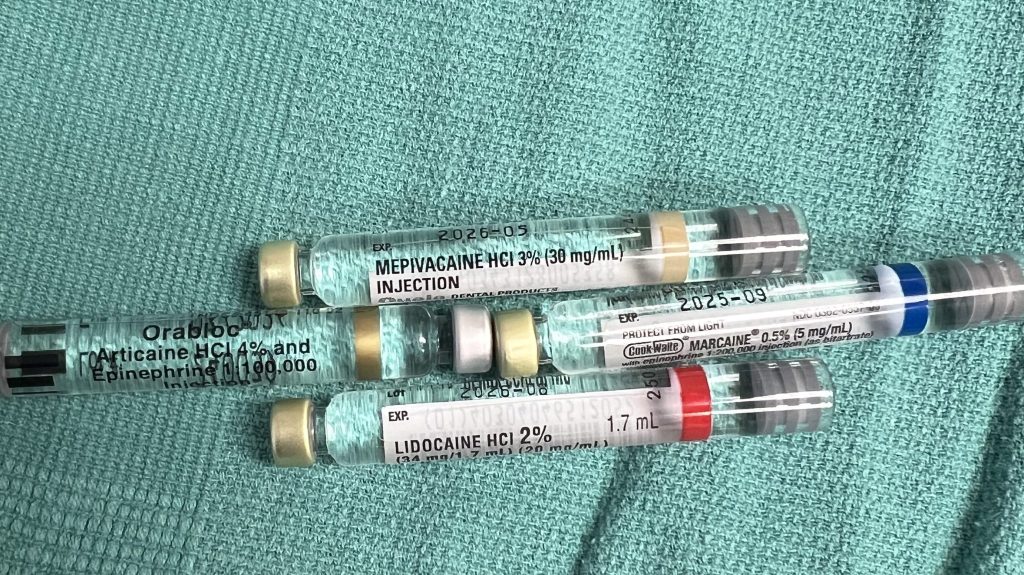
Other common dental local anesthetics include:
Mepivacaine (common brand name: Carbocaine) – usually does not have epinephrine/adrenaline and therefore lasts a shorter period of time.
Articaine (common brand name: Septocaine)- comes in a more potent concentration; great for some purposes, riskier for others (look for a future post for details).
Bupivicaine (common brand name: Marcaine) – a long acting local anesthetic; can last 6-8 hours or sometimes more.
I have another post on allergies to local anesthetics on this site, so I won’t jump into that here. But, essentially, if a patient says they are “allergic to Novocaine” and it truly was Novocaine that was given back in the 1960s or 1970s, then they probably aren’t allergic to what we are currently using.
Discover more from Mouthing Off
Subscribe to get the latest posts sent to your email.
 Mouthing Off