
When your dentist says you need a “crown” they are referring to an artificial covering on your tooth. Another common term for this is a “cap.” They mean the same thing. Take a look at this post about tooth anatomy to see what the structure of a natural tooth is. But here is a quick look:

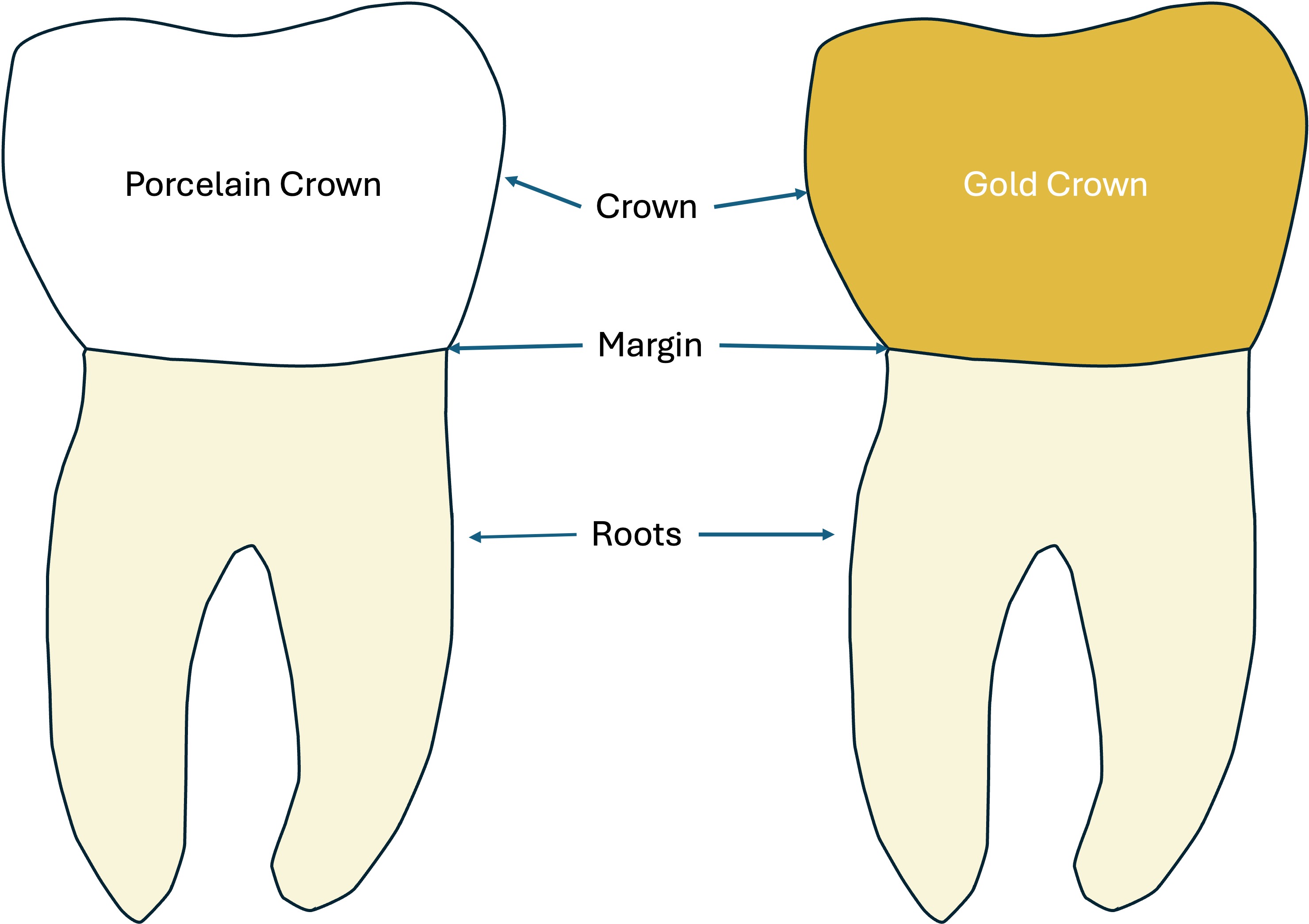
The “pearly white” part of the tooth is the natural crown. When you have a cavity that is big enough, or a large filling that needs to be replaced, your dentist may talk about putting a “crown” or “cap” on the tooth.
Its usually made out of porcelain, ceramic (including a very hard version called “zirconia”), or even gold!
How do they get it to fit on my tooth?
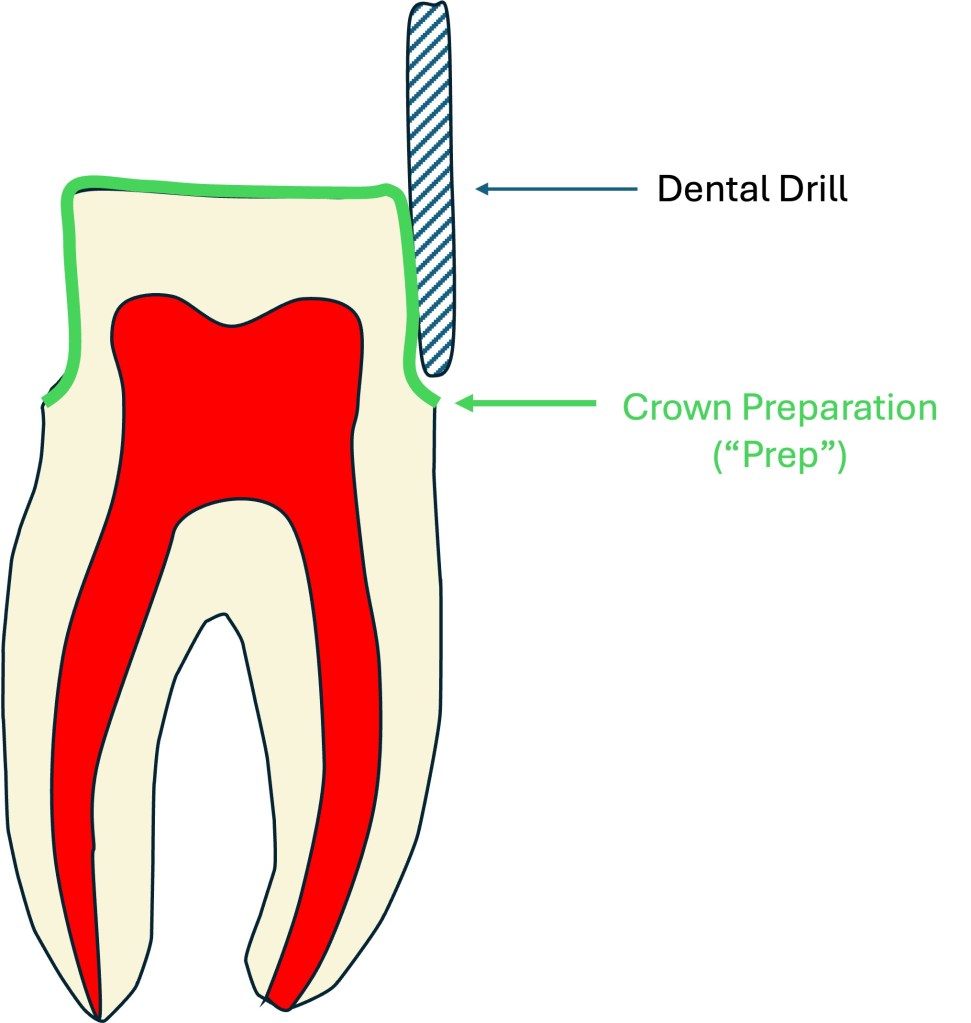
Your dentist will actually shave down the outer layer of your tooth, removing all of the enamel, and enough dentin to make room for this new crown/cap. Then, they will “glue” or cement it onto your tooth.
Some images to illustrate the point:
How is the crown made?
It depends on the material used, your dentist’s preferences, and your unique situation. Traditionally, it is made in a dental lab. Your dentist shaves down, or “prepares” your tooth, then takes an impression or mold. This is sent to a lab where a special technician (who is frankly, an artist), makes the new crown out of whatever material is desired. Your dentist then tries it in over your shaved down tooth, and cements it into place.
In the modern world, some dentists have the ability to make these crowns in their own office (though in some situations, they still need the lab to do it). Also, some dentists may have mini scanners (intraoral scanners) that can quickly take thousands of digital pictures of your tooth rather than using the ooky gooky impression material. They then send this information to the lab to construct your new crown.
Can I still get cavities if I have a crown?
Bad news. Yes, if it is not kept clean. There is always a “margin” (see diagram above) between the crown and your natural tooth, which is a tiny gap. Most modern crown construction minimizes this gap as much as possible, but it still exists. So you will still need to brush/floss this tooth even though it has a crown on it. Unfortunately, there is no way to make a tooth invincible!
When do I need a crown/cap rather than just a filling?
This really depends on whats going on with your tooth. If you have a big cavity, there may not be enough tooth left after the cavity is removed for a filling to hold onto. If you already have a big filling that needs to be replaced…same. Sometimes it depends on how strong a bite you have – your dentist may be worried that you would crack or fracture a filling, where a crown might be more durable. And another consideration may be whether the tooth that needs work is in a cosmetic area – it might just look better to have a crown on the tooth instead of a very large filling!
I just had a root canal and my dentist says I need a crown. Should I get one?
Yes. If your dentist thinks you need a crown to protect the root canal, then get one! We’ve all seen too many root canal treated teeth crack when not properly protected. But more on this in another post.
Discover more from Mouthing Off
Subscribe to get the latest posts sent to your email.
 Mouthing Off